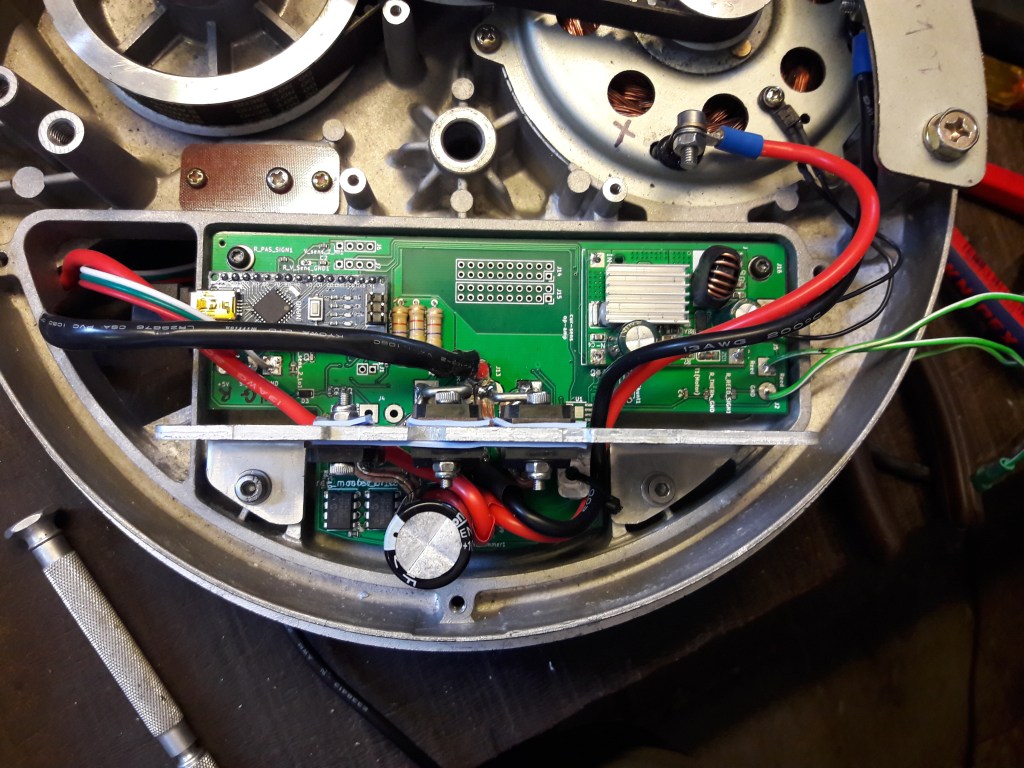
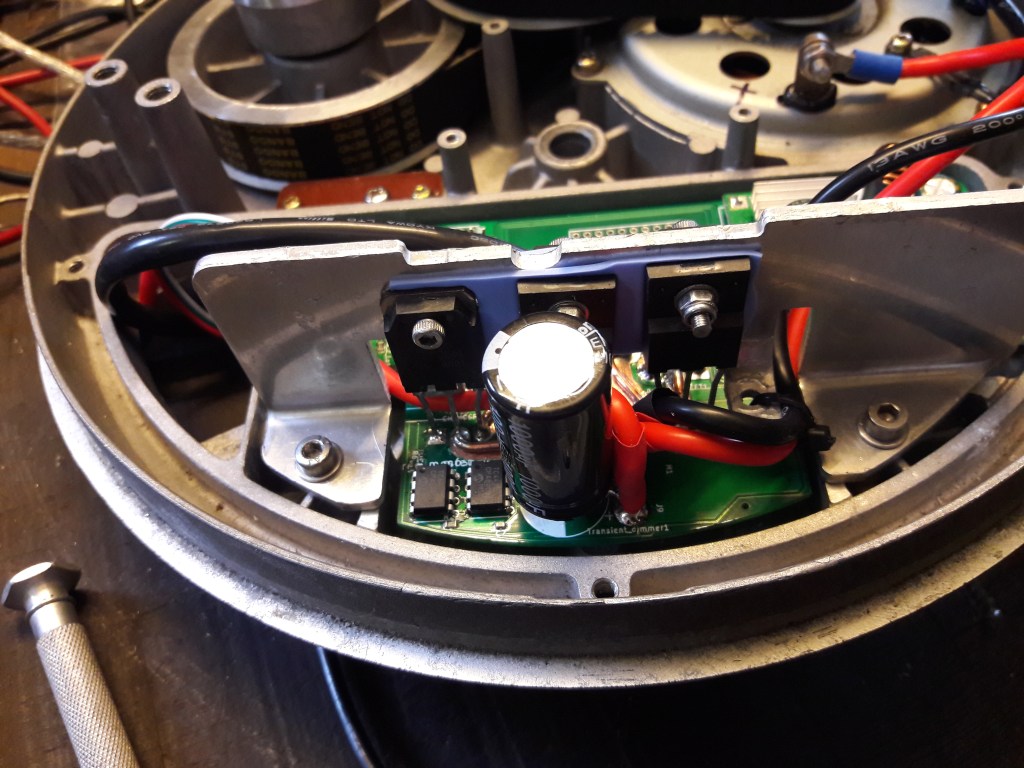
After a first try with 24 V (Li-ion) batteries, I decided I wanted a bit more support from the motor. Also, with the experience from earlier attempts, I wanted to make a more reliable version of my motor controller. I decided to build a 48V battery (13S), and to split the transistor load by channeling the current through 2 parallel transistors rather than one in the original design.
I used the same space as the original controller, and two diodes instead of one: One to leak to ground when the motor potential undershoots, and one to leak to the battery plus when the potential overshoots. I have also built in a large capacitor (not present in the original design), to smooth out the voltage ripple on the battery terminals. In addition, I apply a ‘precharge’ transistor that connects the two capacitor poles to the battery terminal in a smooth way, preventing nasty current peaks at startup. See some pictures and the schema below. Please contact me if you would like the KiCad files when you want to build it yourself.
After experimenting with the bike, I found that 48 V was a bit of overkill for this motor: the motor becomes too warm when continuously operated. I therefore ‘dimmed’ the motor through software by only allowing a maximum PWM duty cycle of 170 out of 256 (66%). In hindsight, a 36V battery pack would have probably been more appropriate.
I have probed the PWM motor driver frequency of an original working unit (CMU-3). To my surprise it was as low as 250 Hz! I think their approach was to quickly move the motor to full drive (always on), which is a reasonable approach at 24 Volt. I am now running the motor at 3.9 kHz PWM, to minimize heat buildup at the motor.
I have made a short overview of the different types of early CMU designs that Sanyo has developed:
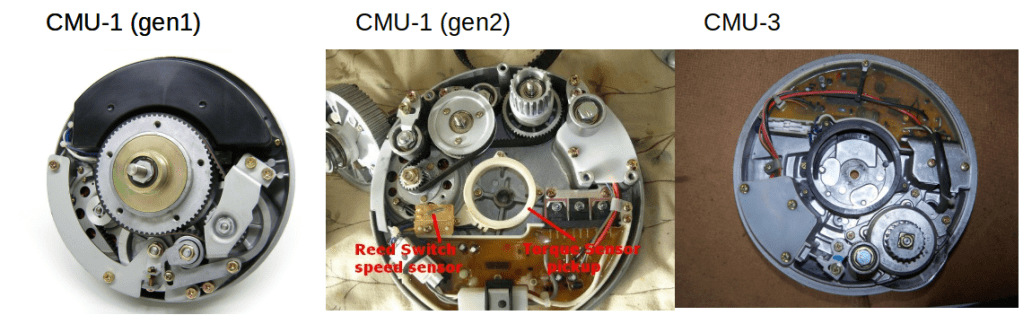
| CMU-1 | CMU-1 (gen2) | CMU-3 (Mercedes) | |
| Wheel speed (reed) sensor? | Yes | Yes | No |
| Torque sensor? | Yes | Yes | Yes |
| Mechanical reduction | Belts (3x) | Belts (3x) | Roller + belt (1x) |
Sources/links:
- https://endless-sphere.com/forums/viewtopic.php?f=2&t=2744&hilit=sanyo+rabbittool (somebody showing the components and working mechanism of the CMU-1 (gen2) hub).


 tinkertalk
Leave a comment